Run Alby Hub with Vultr
Run your own Alby Hub on Vultr using an Ubuntu instance, Docker Compose, and persistent storage on your server.
Prerequisites
Vultr is a good option if you want to run Alby Hub on a simple cloud server with full control over the instance, firewall rules, storage, and updates.
Before you begin, make sure you have:
02
Basic familiarity with running terminal commands
Vultr may require billing details before you can create an instance. Depending on Vultr’s current pricing, your selected server plan, region, backups, bandwidth, and usage, charges may apply. See their pricing page for more details.

Deploy Alby Hub on Vultr
01
Create a Vultr instance
Open the Vultr dashboard and click Create Instance or Deploy Server.
Use the following options:
Type: Shared CPU
Region: Choose the region closest to you
Plan: Cloud Compute
Recommended size: 2 GB memory, 1 vCPU, 55 GB SSD
Image type: Operating System
Operating system: Ubuntu
Image version: Ubuntu 24.04 LTS x64
In Server Hostname and Label, enter a name that helps you recognize this server later, for example: AlbyHub.
02
In the SSH Keys section, add your SSH key if you already have one.
If you do not add an SSH key, Vultr will provide a root password after the server is created. Save this password somewhere safe because you will need it to connect to the server.
For Instance Connectivity, choose Instance(s) with Public IP.
Make sure public IPv4 is enabled. This gives your server a public IP address so you can later open Alby Hub in your browser.
Your Hub will be available at:
03
Review optional features
Vultr may show optional features such as Automatic Backups, DDoS Protection, Limited User Login, and Cloud-Init User Data. Automatic backups can be useful for recovery, but they may add extra cost. Review the option and choose what works for your setup.
For a basic Alby Hub deployment, you can leave the other advanced options unchanged unless you know you need them. Review the deploy summary, then create the instance.
04
Wait for the instance to start
After creating the instance, Vultr will take you to the instance page. Wait until the server status shows that it is running.
On the instance overview page, copy the public IPv4 address. You will need it later to connect to the server and open Alby Hub in your browser.
If you did not add an SSH key, copy the generated root password from the instance overview page.
05
Create and attach a firewall group
Open your Vultr instance page and look for the Firewall section under Settings.
If it shows No Firewall, select an existing firewall group from the dropdown, or create a new one.
You can also create a firewall from the sidebar: Network > Firewall Groups. Create a firewall group with a clear name, for example: albyhub. Attach this firewall group to your Alby Hub instance.
06
Add firewall rules
Open the firewall group and add the following inbound IPv4 rules.
Alby Hub web access
Add a rule for Alby Hub:
Protocol: TCP
Port / Range: 8080
Source: Your IP address for better security, or Anywhere for easier access
Note: accept-inbound-albyhub-8080
Port 8080 is where Alby Hub runs.
Open the Lightning port for LDK
Add a rule for Alby Hub:
Protocol: TCP
Port / Range: 9735
Source: Anywhere
Note: accept-inbound-albyhub-8080
Port 9735 is used for Lightning peer communication.
You do not need to open port 443 for the basic setup unless you configure HTTPS separately with a reverse proxy or custom domain.
After adding all the above rules, it should look something like this:

07
Connect to your Vultr instance
You can connect in either of these ways.
Option A: Use the Vultr web console
Open your Vultr instance page and click the View Console icon.
When the console opens, log in with: root.
Then enter the root password shown on the Vultr instance Overview page.
Option B: Use SSH from your terminal
If you added an SSH key or have password login enabled, connect from your terminal:
Replace YOUR_VULTR_IP with the public IP address of your Vultr instance.
08
Update the server
In the SSH or web console terminal, update the package list and upgrade installed packages:
09
Install Docker and Docker Compose
Install Docker and Docker Compose:
Enable and start Docker:
10
Create a working folder for Alby Hub
Create a folder for your Alby Hub deployment:
The albyhub-data folder stores your Hub data on the server.
11
Add the Docker Compose file
You can either download the official Docker Compose file or create it manually.
Option A: Download the Docker Compose file
Run:
Option B: Create the Docker Compose file manually
Create a new file:
Paste the following content:
You can add restart: unless-stopped to restart Alby Hub automatically when the instance reboots. You will still need to unlock your Hub manually unless auto-unlock is enabled in Alby Hub settings.
Save the file and exit.
In nano, press Ctrl + O, then Enter, then Ctrl + X.
12
Start Alby Hub
Start Alby Hub in the background:
Check that the container is running:
You can also view the logs:
If the logs are running without repeated errors, Alby Hub has started successfully!
Press Ctrl + C to stop following the logs. This does not stop Alby Hub.
13
Open Alby Hub in your browser
Copy the public IP address of your Vultr instance.
Open the following URL in your browser:
For example:
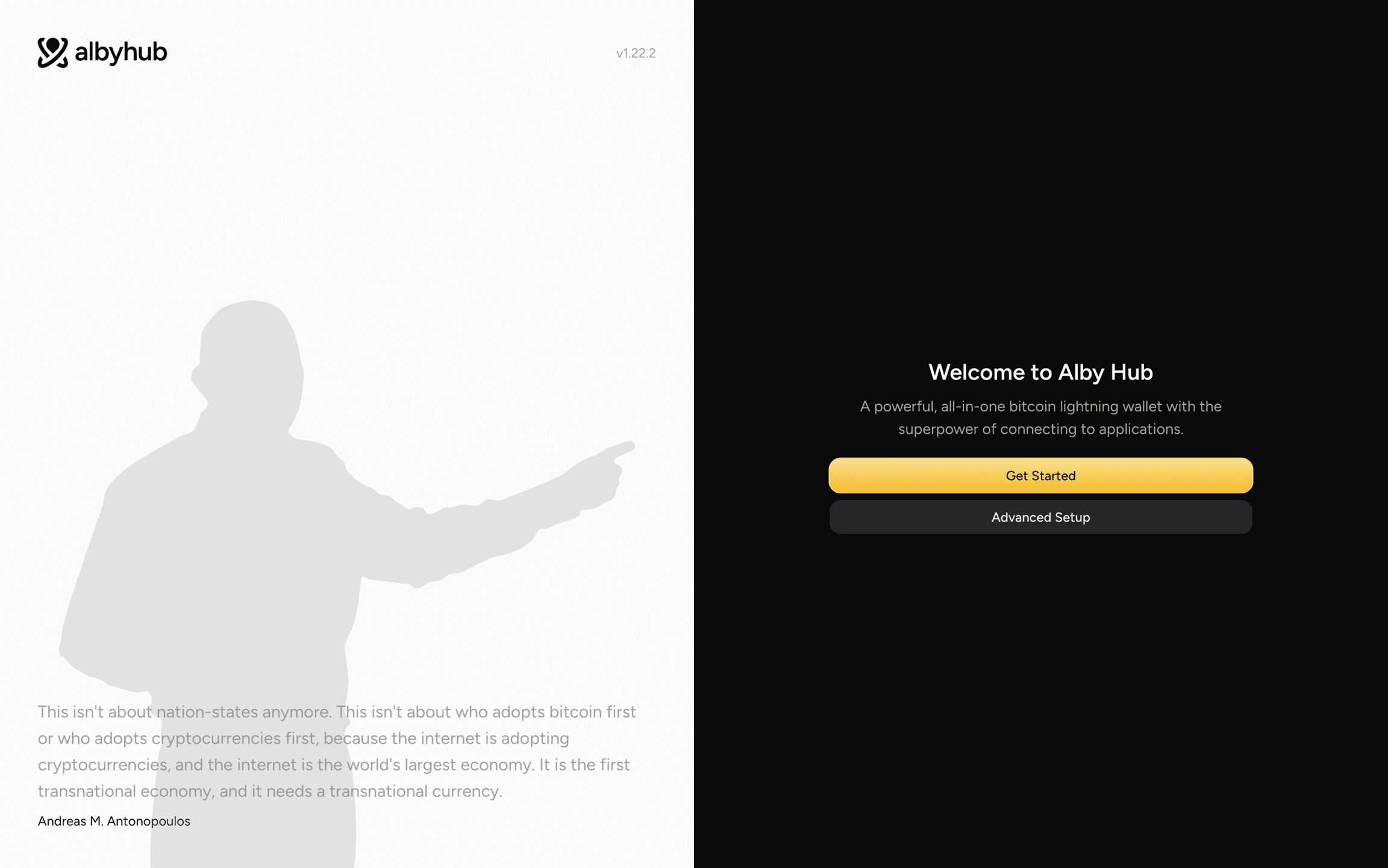
You should see the Alby Hub welcome screen.
14
Set up Alby Hub
Click Get Started and follow the setup flow inside Alby Hub.
During setup, save any important recovery or backup information shown by Alby Hub. Your Hub data is stored on your Vultr instance, but you should still keep your own backup so you can recover or migrate your Hub later.
How to update Alby Hub on Vultr
Alby Hub will show an update banner inside the app when a new version is available.
When you see the update banner, connect to your Vultr instance again and update your deployment.
Go to your Alby Hub folder:
Pull the newest image:
Recreate the container with the new image:
Check that Alby Hub started cleanly:
If there is no new Alby Hub version available, docker compose pull may pull the same image again. You only need to update when Alby Hub shows an update banner or when you know a new release is available.