Published
Category
agentic payments
402, Charted - Tracking the rise of L402, x402, and MPP
Paid HTTP-402 endpoints grew 7× from February to June 2026. A data brief on how L402, x402, and MPP are building the agentic economy's payment layer.

402 Payment Required has sat reserved and unused in the HTTP spec since 1997. Two things finally gave it a use: digital currencies made per-request payment cheap and instant, and agents created something that needed to pay on its own without creating an account upfront. Your agent can discover a tool and pay for it in the same second, with no human to click "subscribe." Three protocols now handle it with a live 402 handshake: the server quotes a price, the client's wallet pays, the request retries and clears.
The numbers here come from 402index.io, an index that tracks all three protocols across February through June 2026. Over those four months, the catalog of paid endpoints grew ~7×.
One status code, three approaches
All three speak 402, but they differ on the rail underneath. L402 settles over Bitcoin's Lightning (Lightning Labs, 2020), x402 over on-chain USDC mostly (Coinbase, 2025), and MPP stays rail-agnostic across card, stablecoin, or Lightning but mostly leaning to USDC on Tempo (Stripe and Tempo, 2026). If you are new to the space this guide walks you through how each one works for agentic commerce.
Most new supply runs on x402
Between February and June, x402 accounted for 59,601 of the 62,079 net new endpoints (96%) and made up 96.5% of the indexed total at the end of June. This concentration is consistent with x402's substantially larger February baseline.
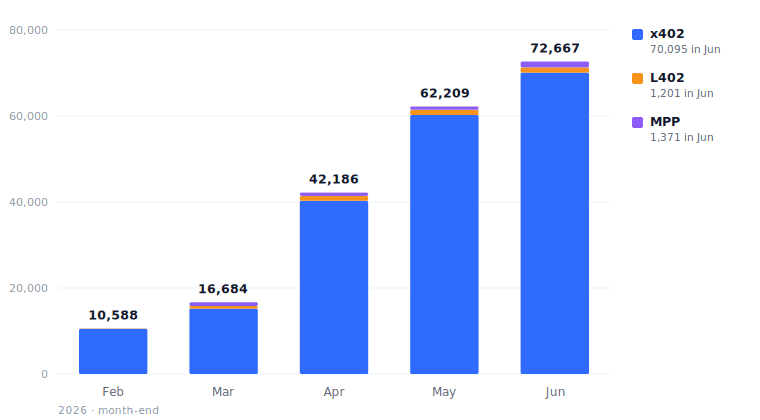
Month-end indexed endpoints, Feb–Jun 2026. Totals labeled above each bar. L402 and MPP are present but too small to read at this scale — see Fig. 02. Source: 402index.io.
A notable growth driver is Apify's announcement on June 30, planning to integrate more than 20,000 actors and making them available through x402. As an established commercial scraping and automation platform, Apify's integration illustrates that 402-based pay per request flows continue being adopted beyond experimental or demonstration environments.
MPP and L402 also add supply
L402 grew from 94 endpoints in February to a peak of 1,209 in May — roughly 13× — then held flat through June, ending the month at 1,201. MPP entered the index in March at 870 endpoints, declined in April, and grew +595 (+77%) in June to 1,371, roughly matching L402 in absolute size. The two protocols show different growth patterns over the same window: L402's is consistent with an established base, while MPP's is consistent with a small number of large integrations landing in a single month. Distinguishing between these explanations would require provider-level data, which is discussed in the next section.
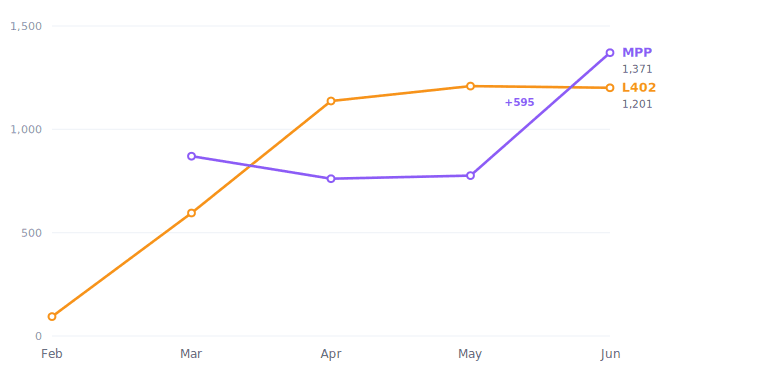
Month-end indexed endpoints, 0–1,500 range. MPP was only announced in March. Source: 402index.io.
Depth appears to be increasing alongside adoption
Endpoint counts measure the number of paid routes, while provider counts measure the number of organizations offering them. The number of indexed hostnames increased from 659 in March to 1,724 in June (+162%). Over the same period, x402 payment-enabled providers grew from 232 to 985, while L402 providers remained relatively stable (36 to 29), consistent with the limited growth in L402 endpoints. MPP providers increased from 24 to 54, representing growth from a comparatively small base.
Comparing endpoint growth with provider growth provides additional context. Because endpoints expanded faster than providers, the average number of paid endpoints per provider increased from approximately 25 in March to 42 in June. This suggests that growth is not driven solely by new providers entering the ecosystem but also by existing providers exposing a larger share of their APIs or services through paid endpoints. While the underlying motivations cannot be determined from these data alone, the trend is consistent with increasing deployment depth among participating providers.

Indexed is 402index's total provider metric (dotted). Per-protocol lines count payment-verified hostnames, a subset, and non-additive across protocols. Mar–Jun 2026.
Protocol composition by endpoint category
Endpoint category labels in this analysis were obtained from 402index.io, which assigns categories to indexed paid endpoints. While these classifications provide useful context, coverage varies substantially across protocols and should be interpreted accordingly. In the June dataset, most L402 and MPP endpoints have category labels, whereas approximately 90% of indexed x402 endpoints remain uncategorized.
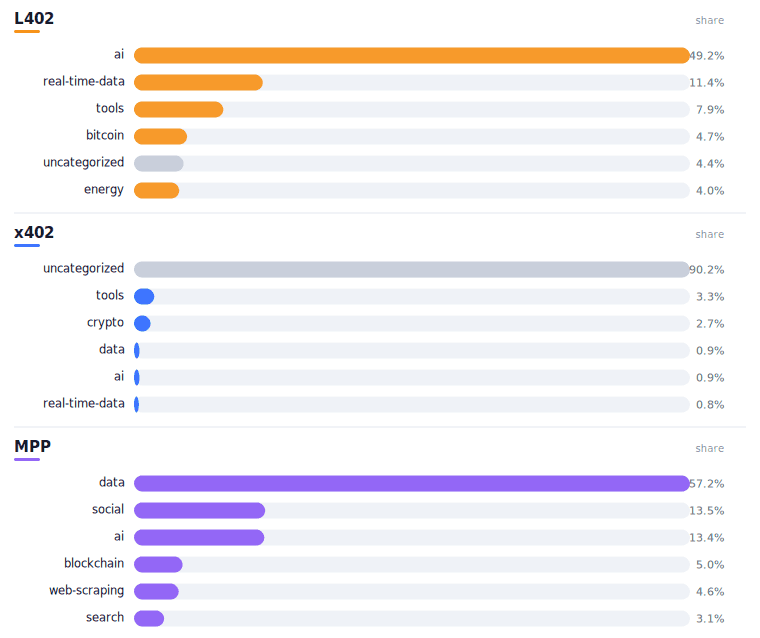
Share of each protocol's endpoints by top-level category, reconstructed June catalog. Bars scaled within each protocol; "uncategorized" shown in gray.
Among the categorized endpoints, 49% of L402 endpoints are classified as AI-related services, while 57% of MPP endpoints fall into data feeds, web scraping, or related infrastructure. For x402, the relatively small set of categorized endpoints spans developer tools, cryptocurrency services, data infrastructure, and real-time information services. However, because these represent only a small fraction of all indexed x402 endpoints, they should not be considered representative of the protocol's overall application mix.
This looks like infrastructure, not a spike
This strong increase in endpoint count could, in principle, be driven by low-value or experimental services. However, several observations suggest a broader pattern. A substantial share of recent additions comes from established providers, including Apify, rather than newly created demonstration repositories. At the same time, the average number of paid endpoints per provider increased from approximately 25 in March to 42 in June, indicating that growth is being driven by both new providers and deeper adoption among existing ones.
Institutional activity has also continued during this period. x402 is now hosted under the Linux Foundation, and MPP is progressing through the IETF standardization process.
Pay any 402 endpoint, on any rail
All three protocols are gaining traction and each of them has their clear strength and advantages. None of the three appears likely to displace the others in the near term.
For developers building AI agents, that means supporting multiple payment protocols. The endpoint an agent needs to access may require a Bitcoin Lightning invoice, a USDC payment on Base, or a transaction through Tempo. In practice, the payment method is determined by the service provider, not the client.
l402.space is a universal 402 gateway between your agent's wallet and everyone else's rail.
1. Your agent can pay endpoints on any rail using its preferred wallet through l402.space, and
2. As a 402 service provider, you can mention l402.space in your docs for agents to pay you over any network. No need to support all protocols and every currency at the same time.
We built it because we were tired of constantly changing our wallets and reconciling by hand.
We hope tools like this give more confidence to people to build upon l402 in particular and increase adoption of agentic payments in general.
So tell your agent about l402.space and it will figure out how to use it. and follow along as more tools ship soon.